



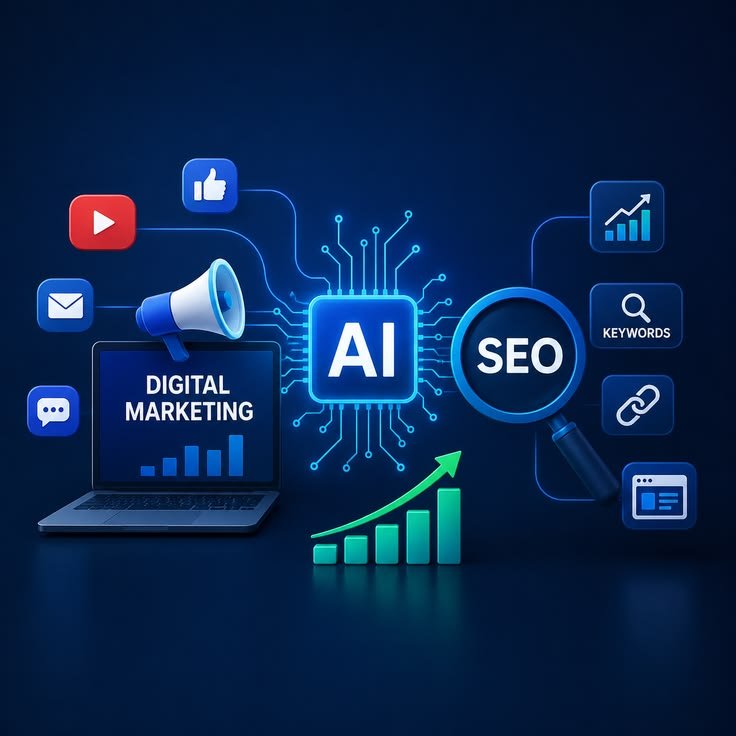
Digital Marketing Solutions for Modern Businesses
Customers increasingly discover businesses through search engines, social media, websites, online reviews, videos, and digital content. This means businesses need more than a website to compete effectively online. They need a coordinated strategy that helps them reach the right audience, communicate their value, and turn online attention into meaningful business opportunities.
This is where Digital Marketing Solutions can help.
Digital marketing combines multiple online channels and strategies to help businesses build visibility, attract potential customers, generate leads, and support long-term growth. Depending on the business, a digital marketing strategy may include SEO, content marketing, social media, paid advertising, email marketing, conversion optimization, analytics, and other digital activities.
The most effective approach is not about being present on every platform. It is about understanding the target audience and selecting the channels that can deliver meaningful results.
What Are Digital Marketing Solutions?
Digital Marketing Solutions are strategies, services, and technologies used to promote a business through digital channels.
These solutions can include:
- Search engine optimization
- Content marketing
- Social media marketing
- Paid advertising
- Email marketing
- Local SEO
- Conversion optimization
- Online reputation management
- Analytics and reporting
- Marketing automation
A business may use one or several of these strategies depending on its goals, industry, audience, and budget.
Why Businesses Need Digital Marketing Solutions
Traditional marketing can still have value, but digital channels provide businesses with new ways to reach and understand their audiences.
Potential customers can discover a company while searching for a solution, watching a video, reading an article, browsing social media, or comparing providers online.
A strong digital marketing strategy can help businesses:
- Increase online visibility
- Reach targeted audiences
- Generate qualified leads
- Improve customer engagement
- Build brand awareness
- Increase website traffic
- Support sales
- Measure marketing performance
The advantage is that businesses can use data to understand which activities are generating meaningful results.
Search Engine Optimization
SEO is one of the most important components of many Digital Marketing Solutions strategies.
Search engine optimization helps businesses improve their visibility for relevant searches.
An SEO campaign may involve:
- Keyword research
- On-page optimization
- Technical SEO
- Content development
- Internal linking
- Local SEO
- Link building
- Performance monitoring
For example, a software development company may target searches related to custom software development, AI development, or web application development.
The focus should be on matching useful content with genuine search intent.
Content Marketing
Content marketing helps businesses educate and engage potential customers.
Content can include:
- Blog posts
- Guides
- Case studies
- Videos
- Infographics
- Whitepapers
- FAQs
- Industry insights
Useful content can help answer customer questions before a sales conversation takes place.
For example, a business selling complex technology services can publish educational articles explaining how different solutions work, what problems they solve, and what businesses should consider before making a decision.
Social Media Marketing
Social media provides businesses with opportunities to communicate directly with their audiences.
Depending on the target market, businesses may use platforms such as:
- YouTube
- X
- TikTok
Social media strategies can focus on:
- Brand awareness
- Educational content
- Product promotion
- Community engagement
- Customer communication
- Video marketing
Businesses should select platforms based on where their customers actually spend time rather than trying to maintain an active presence everywhere.
Paid Digital Advertising
Paid advertising can help businesses reach targeted audiences more quickly than relying exclusively on organic visibility.
Digital advertising may include:
- Search advertising
- Display advertising
- Social media advertising
- Video advertising
- Remarketing campaigns
Paid campaigns should have clear objectives.
For example, a campaign might focus on:
Traffic → Leads → Sales
Simply generating clicks is not enough if those clicks do not contribute to business objectives.
Local Digital Marketing
Businesses that serve specific geographic areas can combine digital marketing with local SEO.
A local strategy can include:
- Google Business Profile optimization
- Local keyword targeting
- Location pages
- Customer reviews
- Local content
- Business listings
- Local link building
This can help businesses become more visible to potential customers searching for services in specific cities or regions.
For businesses serving markets such as Dallas, Austin, Houston, San Antonio, or other Texas locations, location-specific strategies can be useful when those areas genuinely match their service coverage.
Email Marketing
Email marketing can help businesses communicate with existing customers and potential leads.
Businesses can use email campaigns for:
- Newsletters
- Product updates
- Promotions
- Educational content
- Lead nurturing
- Customer onboarding
- Re-engagement
Effective email marketing focuses on relevance.
Sending excessive or irrelevant emails can reduce engagement and damage customer trust.
Conversion Rate Optimization
Getting visitors to a website is only one part of digital marketing.
Businesses also need to consider what visitors do after arriving.
Conversion rate optimization focuses on improving the percentage of visitors who complete a desired action.
This could include:
- Submitting a contact form
- Calling a business
- Requesting a quote
- Booking a consultation
- Purchasing a product
- Signing up for a service
- Downloading a resource
Improving page structure, messaging, navigation, calls to action, and user experience can help businesses turn more relevant traffic into leads or customers.
Data and Analytics
Digital marketing becomes more effective when businesses understand what is working.
Analytics can provide insights into:
- Website traffic
- Traffic sources
- User behavior
- Search performance
- Campaign results
- Lead generation
- Conversion rates
- Customer engagement
Businesses can use this information to identify successful strategies and reduce investment in activities that are not producing useful results.
Marketing Automation
Marketing automation can help businesses streamline repetitive marketing activities.
Automation may be used for:
- Email sequences
- Lead nurturing
- Customer segmentation
- Notifications
- Follow-ups
- Campaign workflows
- Reporting
Automation does not mean removing the human element from marketing.
Instead, it can reduce repetitive work and allow marketing teams to focus on strategy, creativity, and customer relationships.
AI in Digital Marketing
Artificial intelligence is becoming increasingly useful across digital marketing.
Businesses can explore AI for:
- Content research
- Customer segmentation
- Personalization
- Recommendation systems
- Predictive analytics
- Chatbots
- Marketing automation
- Customer support
- Campaign analysis
AI can help process large amounts of information and identify patterns that may be difficult to analyze manually.
However, businesses should use AI responsibly and maintain human oversight where appropriate.
For organizations exploring responsible AI practices, the NIST AI Risk Management Framework provides useful guidance for managing AI-related risks.
Personalization in Digital Marketing
Customers increasingly expect relevant digital experiences.
Personalization can involve adapting content, recommendations, offers, or communications according to customer behavior and preferences.
For example, an e-commerce business may recommend products based on browsing activity.
A B2B company may provide different content depending on the visitor’s industry or stage in the buying journey.
Personalization should always be balanced with appropriate data protection and responsible use of customer information.
Digital Marketing for E-commerce Businesses
E-commerce businesses often depend heavily on digital marketing to attract customers.
A comprehensive strategy may combine:
- SEO
- Product content
- Paid search
- Social media
- Email marketing
- Retargeting
- Conversion optimization
- Product recommendations
The customer journey may look like:
Search → Product Page → Evaluation → Purchase → Retention
Digital marketing can support multiple stages of this journey.
Digital Marketing for B2B Businesses
B2B companies often have longer buying cycles.
Potential customers may research a company extensively before contacting sales.
Content such as:
- Industry guides
- Case studies
- Technical articles
- Service pages
- Research reports
- Webinars
can help businesses demonstrate expertise and answer questions throughout the buying process.
LinkedIn and search marketing can also be useful channels for reaching professional audiences, depending on the industry.
Digital Marketing and Brand Building
Marketing is not only about immediate sales.
Consistent digital communication can help businesses build recognition and credibility over time.
Brand-building activities can include:
- Consistent visual identity
- Educational content
- Thought leadership
- Social media engagement
- Customer stories
- Professional website design
- Positive reviews
A strong brand can make it easier for customers to remember and recognize a business when they are ready to purchase.
Mobile-First Digital Marketing
A significant portion of digital activity happens on mobile devices.
Businesses should therefore ensure that marketing campaigns work effectively across smartphones and tablets.
Important considerations include:
- Responsive websites
- Fast-loading pages
- Mobile-friendly forms
- Easy navigation
- Readable content
- Clear calls to action
A potential customer should not have to struggle with a website before being able to contact a business.
Digital Marketing and Website Experience
Marketing and website development should work together.
A successful campaign can bring visitors to a website, but a poor website experience can prevent those visitors from converting.
Businesses should ensure that landing pages:
- Match the advertising message
- Explain the offer clearly
- Load quickly
- Work on mobile devices
- Provide clear next steps
- Build trust
This is why digital marketing should not operate separately from the overall digital experience.
How to Build an Effective Digital Marketing Strategy
A practical strategy can follow a structured process.
1. Define Business Goals
Determine whether the priority is:
- Brand awareness
- Leads
- Sales
- Website traffic
- Customer retention
- Market expansion
2. Understand the Target Audience
Research customer needs, problems, interests, search behavior, and purchasing decisions.
3. Select the Right Channels
Choose marketing channels based on the audience and business objectives.
4. Create Useful Content
Develop content that answers customer questions and demonstrates expertise.
5. Optimize the Website
Make sure the website provides a fast, secure, mobile-friendly, and conversion-focused experience.
6. Launch Campaigns
Implement SEO, paid advertising, social media, email, or other relevant marketing activities.
7. Measure Results
Monitor traffic, leads, conversions, engagement, and return on marketing investment.
8. Improve Continuously
Use performance data to refine campaigns and focus resources on strategies producing meaningful outcomes.
Common Digital Marketing Mistakes
Businesses can waste time and money by making avoidable mistakes.
Targeting Everyone
A broad audience is not always a useful audience. Marketing should focus on customers who are most relevant to the business.
Focusing Only on Traffic
High traffic does not automatically mean high revenue.
Ignoring Conversion Rates
Businesses need to understand what happens after visitors arrive.
Using Every Social Platform
Being active everywhere can spread resources too thin.
Publishing Without Strategy
Content should serve a purpose instead of being published simply to increase the number of articles.
Ignoring Data
Without analytics, businesses may continue investing in strategies that are not producing meaningful results.
Why Businesses Choose HiveRift for Digital Marketing Solutions
Effective digital marketing often requires multiple capabilities working together.
HiveRift combines digital marketing with website development, SEO, local SEO, e-commerce development, AI solutions, and other technology services.
This broader approach can help businesses connect marketing activities with the websites, applications, and digital experiences customers interact with.
Businesses looking to strengthen their online presence can explore HiveRift’s digital marketing and technology solutions.
The objective is to create a digital strategy that supports genuine business goals rather than focusing on individual marketing channels in isolation.
The Future of Digital Marketing
Digital marketing continues to evolve as search, AI, social platforms, analytics, and customer expectations change.
Businesses are increasingly exploring:
- AI-powered marketing
- Predictive analytics
- Personalized experiences
- Conversational marketing
- Automated customer journeys
- Short-form video
- Voice and visual search
- Advanced customer segmentation
Technology will continue to change how businesses reach customers.
However, the fundamentals remain important: understand the customer, communicate clearly, provide value, and measure results.
Conclusion
Digital Marketing Solutions can help businesses build visibility, reach relevant audiences, generate leads, improve customer engagement, and support sustainable growth.
A successful digital marketing strategy is not simply about running advertisements or publishing social media posts. It requires a coordinated approach involving search visibility, content, websites, customer experiences, analytics, and continuous optimization.
Businesses that understand their audiences and focus their resources on the channels that genuinely support their goals can build a stronger and more sustainable digital presence.
With the right strategy, digital marketing can become more than a promotional activity. It can become an important part of how a business attracts, engages, converts, and retains customers.


