
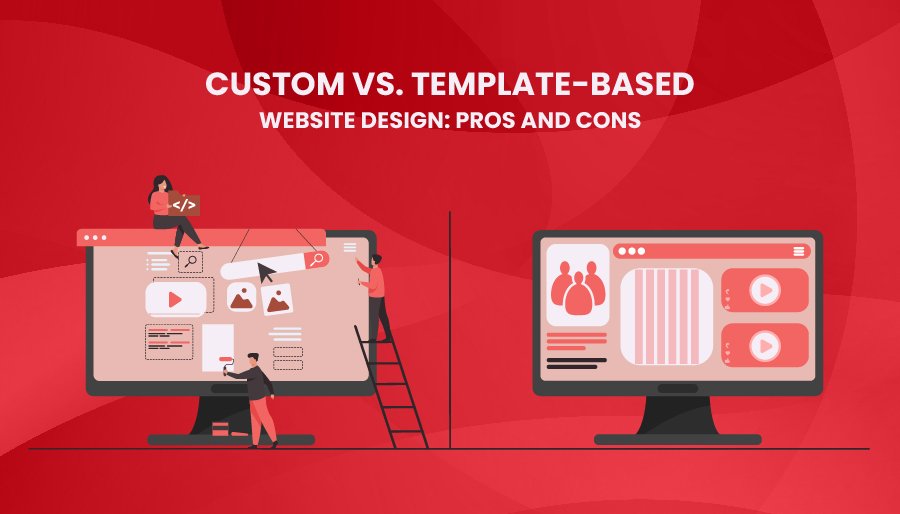
Custom Website Development vs. Website Builders: Which Is Right for Your Business?
Starting a business website has never felt easier. You can choose a template, add your logo, write a few lines about your services, and publish a website without writing a single line of code.
So why do businesses still invest in custom website development?
The answer becomes clearer when a business starts growing.
A website that works perfectly well when you have five services, a small customer base, and a simple enquiry form may become limiting when you introduce new products, build more complex customer journeys, or need your website to connect with other business systems.
On the other hand, spending heavily on a custom website before you understand your customers or business requirements can be just as unnecessary.
There is no universal winner in the debate between custom website development and website builders. The right choice depends on what you are trying to achieve, how much flexibility you need, and how you expect your business to develop.
Let’s look at the differences without assuming that the more expensive option is automatically the better one.
What Is Custom Website Development?
Custom website development involves creating a website around specific business requirements rather than relying entirely on a prebuilt website template.
Depending on the project, a developer may create custom layouts, interactive features, integrations, databases, and workflows. The website can be designed around how the business operates and how its customers need to interact with it.
For example, a business might need a customer portal, a specialized booking process, a product configurator, or a connection between its website and an internal management system.
A standard template may not provide everything required. Custom development can offer greater control over the functionality and user experience.
However, custom does not necessarily mean that every component must be built from scratch. Developers can use established frameworks, content management systems, libraries, and third-party services where appropriate.
The objective is to create a solution that fits the business without adding unnecessary complexity.
What Is a Website Builder?
A website builder is a platform that allows people to create and manage websites using ready-made templates, visual editors, and prebuilt features.
Many builders offer hosting, design tools, mobile-friendly templates, forms, and integrations within one service. The exact features depend on the platform and subscription.
This approach can be especially useful for people who want to launch quickly without managing a complicated development process.
A freelancer may need a simple portfolio. A local business may want a website with service descriptions and contact details. A new company may need a landing page to test whether customers respond to its offer.
In these situations, a website builder can be a practical choice.
Popular options include Wix, Squarespace, and Shopify for businesses with different website and eCommerce needs.
The important thing is to evaluate what a platform actually supports before committing to it. Not every builder offers the same level of customization, integration, or control.
Custom Website Development vs. Website Builders: Key Differences
1. Initial Cost and Long-Term Budget
Cost is often the first thing business owners compare, and for good reason.
Website builders typically offer a lower barrier to entry. You can often start with a template and a subscription rather than paying for a fully custom development project.
Custom website development usually requires a larger initial investment because the work may involve planning, design, programming, testing, and specialized functionality.
But the initial price does not tell the whole story.
A website builder may involve recurring subscriptions, premium extensions, transaction fees, or paid integrations. A custom website may require ongoing hosting, maintenance, security updates, and developer support.
Neither option is automatically cheaper over its entire lifespan.
Before deciding, estimate the costs over the next two or three years. Include the platform or hosting, required features, maintenance, updates, and any support you expect to need.
A low-cost website that cannot support an important business process may eventually require a rebuild. Equally, a custom solution with unnecessary features can consume money that would have been better spent elsewhere.
The smarter choice is the one that provides the functionality you need at a cost your business can justify.
2. Design Flexibility and Brand Identity
Website builders provide templates that can make a business look professional without a lengthy design process.
For many businesses, that is enough.
You can often adjust colors, typography, images, layouts, and other visual elements to create a website that reflects your brand.
However, some platforms restrict how much you can change the underlying layout or behavior. You may eventually find yourself trying to work around a template rather than designing the experience you actually want.
Custom website development gives a project more room to accommodate specific design requirements. The layout, navigation, content structure, and interactions can be planned around the intended audience and business objectives.
This can be valuable for companies with unusual products, specialized services, or a distinctive customer journey.
Still, a custom design is not automatically better. A simple, well-organized template can be more effective than an expensive website filled with unnecessary visual effects.
What matters is whether the design communicates your value clearly and helps visitors accomplish their goals.
3. Functionality and Integrations
A website should support the way your business operates.
If you only need service pages, a contact form, a blog, and a few testimonials, a website builder may provide everything required.
But requirements can become more complicated.
Perhaps you want customers to configure products before purchasing. Maybe your website needs to synchronize information with a CRM, display information from an internal database, or provide different experiences for different user types.
Some website builders can handle advanced requirements through apps, plugins, APIs, or custom code. Others may impose restrictions that make certain workflows difficult or impractical.
Custom development offers more control over how specialized functionality is implemented, although it also creates responsibility for building, testing, documenting, and maintaining those features.
Before choosing either option, write down the essential features your business needs today and the capabilities it is likely to require later.
Then verify that your chosen approach can support them.
4. Website Speed and Performance
A fast website helps visitors access information without unnecessary waiting.
However, the development method alone does not determine website performance.
A website builder can deliver a fast experience when its templates, images, scripts, and content are well managed. A custom website can become slow when it uses inefficient code, oversized images, or too many unnecessary scripts.
The same principle applies to both: performance needs to be considered throughout the project.
Pay attention to image optimization, mobile usability, hosting quality, page structure, and the number of resources each page needs to load.
You can evaluate real performance opportunities with Google PageSpeed Insights.
If speed is important to your business, compare actual performance and technical capabilities instead of assuming that a custom website will always outperform a builder.
5. SEO and Search Visibility
A common misconception is that custom websites automatically rank better on Google.
They do not.
Search visibility depends on many factors, including content relevance, technical accessibility, competition, site structure, links, and how well the website satisfies the searcher’s needs.
Both custom websites and website builders can support effective SEO when configured properly.
Your website should allow you to manage essential elements such as page titles, meta descriptions, headings, image alt text, internal links, canonical URLs, and indexing settings where relevant.
You should also be able to create useful content and maintain a logical structure as your website grows.
Some platforms make these tasks straightforward through built-in tools. Others may impose limitations that become important for more advanced requirements.
Google’s SEO Starter Guide provides a useful foundation for understanding how search engines discover and interpret website content.
Choose the approach that lets you implement the SEO work your business actually needs. Neither a custom build nor a website builder can guarantee search rankings.
6. Maintenance and Security
Every website needs ongoing attention, regardless of how it was created.
Website builders often manage much of the underlying infrastructure, which can reduce the technical work required from the website owner. However, you may still need to manage account security, content updates, permissions, integrations, and platform-specific settings.
With a custom website, responsibilities depend on the technology and hosting arrangement. You may need to coordinate software updates, dependency management, backups, monitoring, and security fixes.
Custom development can give you more control, but control also brings responsibility.
Ask who will maintain the website after launch, how problems will be handled, and what happens if a critical feature stops working.
A website is not truly affordable if you cannot maintain it reliably.
7. Ownership and Platform Flexibility
Before choosing a platform, understand what you can export, migrate, and control.
Website builders can make daily management convenient, but moving a website to another platform may require rebuilding parts of the design, content structure, or functionality. The extent of this limitation varies considerably between platforms.
Custom websites can provide greater control over code, data, and hosting when those elements are included in the project arrangement. But ownership should never be assumed simply because a website was custom-built.
Your agreement should clearly explain access to the source code, domain, hosting accounts, content, databases, licenses, and third-party services.
If you ever change developers or hosting providers, you should understand what can be transferred and what additional work may be required.
This is especially important for businesses that expect their digital operations to become more sophisticated over time.
When Is a Website Builder the Better Choice?
A website builder may be the right option when your requirements are straightforward and speed matters more than deep customization.
Consider this approach if:
- You need a simple business website or portfolio.
- Your budget is limited and you want to launch quickly.
- Your website mainly presents information about your services.
- You need basic forms, booking features, or standard eCommerce capabilities.
- You want to update content without relying on a developer for every small change.
- Your selected platform already supports the integrations you need.
Imagine a consultant launching a new business. They need a homepage, a few service pages, a professional profile, testimonials, and a booking link.
Building a completely custom system may not offer enough additional value to justify its cost.
A well-chosen builder could help the consultant establish an online presence, learn what customers respond to, and invest in more advanced functionality later if needed.
Starting simple is not a weakness. It can be a sensible business decision.
When Should You Consider Custom Website Development?
Custom development becomes more attractive when your business needs exceed what an existing platform can reasonably support.
It may be worth considering if:
- Your business needs specialized workflows or interactive features.
- Your website must integrate deeply with internal business systems.
- Your customer journey cannot be implemented effectively with existing templates or extensions.
- You need specific control over the architecture or user experience.
- Your website supports important business operations that require carefully defined functionality.
- Your long-term plans justify the additional development and maintenance responsibilities.
Consider a company that sells configurable products. Customers must select several specifications, receive a calculated price, submit an order, and have the details transferred to an internal system.
If the workflow is too specialized for the available platform tools, custom development may provide a better fit.
The decision should still be based on requirements, not on the idea that every serious business needs a custom website.
A Practical Comparison Before You Decide
Use this quick comparison to organize your thinking.
| Requirement | Website builder | Custom development |
|---|---|---|
| Quick initial launch | Often a strong fit | Depends on project scope |
| Low initial budget | Often a strong fit | Usually requires more investment |
| Simple business pages | Often sufficient | May be unnecessary |
| Highly specialized features | Depends on platform capabilities | More implementation flexibility |
| Deep system integrations | Depends on available tools | Can be designed around requirements |
| Ongoing technical control | Varies by platform | Depends on architecture and ownership |
| Maintenance responsibility | Some infrastructure may be managed | Depends on the hosting and support arrangement |
This is a general comparison, not a guarantee about every platform or project. Some builders support sophisticated functionality, while some custom websites rely heavily on third-party services.
The details of your chosen solution matter more than the label attached to it.
Seven Questions to Ask Before Investing in a Website
Before you commit to a platform or development project, answer these questions honestly.
1. What should the website accomplish?
Are you trying to generate enquiries, sell products, showcase a portfolio, provide customer support, or support an internal process?
The primary goal should guide the project.
2. What features are essential at launch?
Separate the features you genuinely need from the ones that would simply be nice to have.
3. Who will manage the website?
Consider whether you have the time and skills to update content, manage integrations, and handle routine maintenance.
4. What is your realistic budget?
Include initial development, recurring fees, hosting, maintenance, content, and likely future improvements.
5. How will the business grow?
You do not need to predict every future requirement. However, you should identify foreseeable changes that could influence the platform decision.
6. What can you migrate if your needs change?
Understand your access to content, data, source code, domain settings, and essential accounts.
7. How will you measure success?
Decide whether success means more qualified enquiries, online sales, bookings, improved usability, or another measurable business outcome.
Answering these questions makes the decision much more useful than simply asking which option is cheaper or more advanced.
Can You Start With a Website Builder and Upgrade Later?
Absolutely. For some businesses, this is a sensible way to reduce initial risk.
A new company may not know which services will attract the most interest or which customer journeys will produce the best results.
Starting with a website builder can help establish an online presence while the business gathers real feedback.
As the company grows, it can review whether the current platform still meets its needs.
The transition may involve improving the existing website, adding integrations, changing platforms, or commissioning custom development for specific features.
However, upgrading later is not always effortless. Content migration, URL changes, redirects, data transfer, integrations, and SEO continuity need to be planned carefully.
If you expect to migrate in the future, keep your content organized, retain access to important accounts, and avoid unnecessary dependence on tools that cannot support your long-term plans.
The goal is to make today’s decision practical without making tomorrow’s options unnecessarily difficult.
Common Mistakes to Avoid When Choosing a Website Solution
One mistake is choosing the cheapest option without checking whether it meets your actual requirements. A low initial price is less useful if the platform cannot support a critical feature.
Another is paying for custom development simply because it sounds more professional. If a standard platform already solves your problem, custom work may add cost and complexity without enough benefit.
Businesses also sometimes focus entirely on design while ignoring content, usability, maintenance, and the customer journey.
Finally, some owners assume that launching the website completes the project. In reality, the website needs monitoring, updates, and improvements as the business changes.
A strong decision balances budget, functionality, flexibility, maintenance, and the needs of the people who will use the website.
Frequently Asked Questions
Is custom website development better than a website builder?
Neither option is universally better. Custom website development can suit businesses with specialized functionality and integration needs, while website builders can be ideal for simpler projects that need a quick, cost-effective launch.
Is a custom website more expensive?
Custom projects often require a larger initial investment, but total costs depend on the scope, platform, hosting, maintenance, and future changes. Compare the full expected cost rather than the initial quote alone.
Can website builders rank on Google?
Yes. Website builders can support effective SEO when the website has useful content, an appropriate structure, accessible pages, and correct technical settings. Rankings are never guaranteed by the platform alone.
Can a website builder handle eCommerce?
Many website builders offer eCommerce features, including product listings, checkout, and payment integrations. The right choice depends on your catalog, transaction requirements, integrations, and the platform’s available features.
Do I need a developer for a custom website?
Most custom projects require professional development expertise, especially when they involve complex functionality, integrations, security requirements, or specialized architecture. The level of ongoing support depends on how the website is built and maintained.
How do I know when it is time to upgrade my website?
Consider an upgrade when your current platform consistently prevents important improvements, cannot support essential functionality, or creates operational limitations that justify the cost of changing. A larger website is not automatically a reason to rebuild.
Final Thoughts: Choose the Website That Fits Your Business
The choice between custom website development and a website builder is not really about deciding which technology is superior.
It is about understanding what your business needs today and choosing a solution that can support those needs without creating unnecessary cost or complexity.
If your website mainly communicates information and generates straightforward enquiries, a website builder may be more than enough.
If your business depends on specialized workflows, advanced integrations, or a carefully designed digital experience, custom development may be worth the investment.
Take the time to define your goals, list your essential features, compare the total cost, and understand your ongoing responsibilities.
A good website is not necessarily the most complicated one. It is the one that helps your customers accomplish their goals while supporting your business in a practical, sustainable way.
If you are planning a new website or considering improvements to your existing digital presence, visit HiveRift to explore its online presence and available digital solutions.
Build around your business goals first. Choose the technology second.