



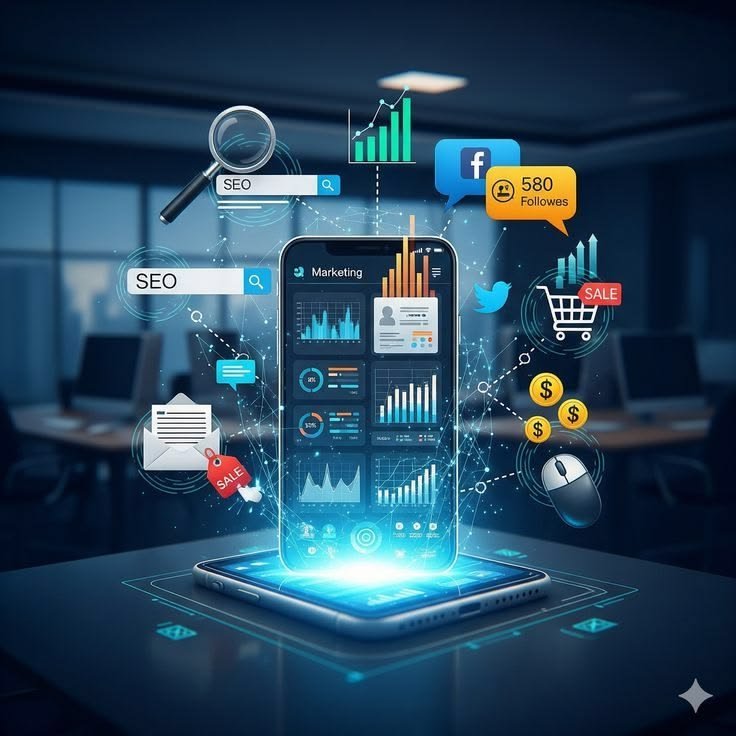
AI Marketing Automation: Smarter Digital Campaigns
Marketing has become more complex than ever.
Businesses communicate with customers through search engines, websites, email, social media, advertising platforms, and messaging channels. Managing all these activities manually can quickly become difficult.
Marketing teams need to create content, analyze campaigns, segment audiences, follow up with leads, monitor performance, and adjust strategies.
This is where AI marketing automation can provide practical support.
By combining artificial intelligence with marketing automation, businesses can streamline repetitive activities, analyze large amounts of campaign data, personalize customer experiences, and help marketers make faster decisions.
The objective isn’t to remove marketers from the process.
It is to give them more time to focus on strategy, creativity, brand development, and customer relationships.
What Is AI Marketing Automation?
AI marketing automation means using artificial intelligence to make marketing workflows more efficient and intelligent.
Traditional automation may work like:
Trigger → Rule → Action
AI can add analysis and decision support:
Customer Activity → AI Analysis → Decision → Marketing Action
For example, a visitor who downloads a business guide may enter a marketing workflow.
AI could help classify the visitor based on approved information and determine the appropriate next step.
Why Businesses Use AI Marketing Automation
Marketing teams often perform repetitive tasks.
These may include:
- Email segmentation
- Campaign reporting
- Lead qualification
- Customer categorization
- Content research
- Follow-up reminders
- Performance analysis
AI can assist with many of these activities.
Potential benefits include:
- Time savings
- Faster campaign analysis
- Better personalization
- Improved workflow management
- More efficient lead nurturing
AI Customer Segmentation
Not every customer has the same needs.
AI can help businesses organize customers into relevant groups based on approved information.
For example:
Customer Data → AI Analysis → Audience Segment → Marketing Campaign
Segments might be based on:
- Previous purchases
- Product interest
- Website interactions
- Engagement
- Business characteristics
Segmentation should be based on useful business criteria rather than unnecessary data collection.
AI for Email Marketing
Email marketing includes many repetitive activities.
AI can help marketers:
- Organize audiences
- Analyze engagement
- Draft content
- Identify campaign patterns
- Suggest follow-up actions
A simplified workflow could be:
Customer Activity → AI Analysis → Segment → Email Workflow
Marketers should review AI-generated messages to ensure accuracy, brand consistency, and appropriate tone.
AI Lead Nurturing
Not every lead is ready to make a purchase immediately.
Marketing automation can keep prospects engaged through relevant communication.
AI can assist by analyzing available engagement information and helping determine which type of content may be useful.
For example:
Lead Activity → AI Analysis → Customer Stage → Relevant Communication
This can create a more organized lead-nurturing process.
AI for Content Marketing
Content marketing requires continuous research and planning.
AI can assist marketers with:
- Topic discovery
- Content outlines
- Research organization
- Search-intent analysis
- Content performance analysis
For example:
Search Data → AI Analysis → Content Opportunity → Marketing Team
AI-generated content should still be reviewed and improved by humans.
Original insights, experience, and accurate information remain important.
AI and SEO
AI can assist SEO teams with research and analysis.
Potential uses include:
- Keyword research
- Search intent analysis
- Topic clustering
- Content gap analysis
- Website content organization
- Performance reporting
However, AI should support SEO strategy rather than simply generating large amounts of content.
Useful content should ultimately be created for people.
AI Campaign Optimization
Marketing campaigns generate large amounts of data.
AI can help identify patterns in:
- Click-through rates
- Conversions
- Engagement
- Customer acquisition
- Campaign costs
A workflow could be:
Campaign Data → AI Analysis → Performance Insight → Marketer Decision
This can help marketers investigate underperforming campaigns more quickly.
AI for Advertising
Paid advertising platforms generate continuous performance information.
AI can help marketers analyze:
- Audience performance
- Campaign results
- Conversion patterns
- Ad engagement
- Customer acquisition costs
The goal is not to blindly accept every automated recommendation.
Marketing teams should review campaign data and make decisions based on business objectives.
AI Personalization
Personalization is an important part of modern marketing.
AI can help businesses provide more relevant experiences.
For example:
Customer Activity → AI Analysis → Relevant Segment → Personalized Experience
Personalization can appear in:
- Website content
- Emails
- Product recommendations
- Advertising
- Offers
- Customer journeys
Businesses should use appropriate data practices and avoid personalization that feels intrusive.
AI for Social Media Marketing
Social media teams manage large amounts of content and engagement data.
AI can assist with:
- Content planning
- Engagement analysis
- Topic research
- Performance summaries
- Audience analysis
A useful workflow is:
Social Data → AI Analysis → Insight → Content Strategy
Human creativity remains important because social media depends heavily on tone, context, culture, and brand identity.
AI Marketing Workflow Automation
AI becomes especially useful when multiple marketing activities are connected.
For example:
Website Form → AI Lead Classification → CRM → Email Workflow → Sales Notification
Another example:
Customer Purchase → CRM → AI Segmentation → Personalized Follow-Up
Connecting these steps can reduce manual work.
AI for Marketing Analytics
Marketing teams need to understand whether campaigns are actually producing results.
AI can help summarize:
- Website traffic
- Lead generation
- Conversion rates
- Campaign performance
- Customer engagement
- Advertising results
A manager could ask:
“Which marketing channel generated the most qualified leads this month?”
An AI analytics system can retrieve authorized data and provide a summary for review.
AI and Customer Journey Automation
Customers may interact with a company across multiple channels.
A typical journey might look like:
Advertisement → Website → Content → Inquiry → Email → Sales Conversation → Purchase
AI can help analyze customer activity and trigger appropriate workflows.
For example:
Customer Action → AI Analysis → Journey Stage → Next Marketing Action
This can make marketing journeys more responsive.
AI Marketing Automation for Small Businesses
Small businesses can also use AI marketing automation.
They don’t need a large marketing department to start.
A small company could automate:
- Email follow-ups
- Lead categorization
- Campaign reporting
- Customer segmentation
- Content research
The best starting point is usually one repetitive process.
AI and Marketing Data
Marketing automation depends on data.
Businesses may use information from:
- Websites
- CRM systems
- Email platforms
- Advertising platforms
- Analytics tools
- E-commerce systems
Connecting these sources can provide a more complete picture of customer interactions.
However, businesses should only collect and use information appropriately and maintain proper access controls.
Security and Privacy
Marketing systems can contain customer and prospect information.
Businesses should consider:
- Authentication
- Authorization
- Data protection
- Secure API connections
- Access controls
- Monitoring
The NIST AI Risk Management Framework provides useful guidance for organizations considering responsible AI adoption.
How to Implement AI Marketing Automation
1. Identify a Marketing Problem
Find a repetitive activity that consumes significant time.
2. Map the Current Workflow
Document each step.
3. Choose an AI Use Case
Start with segmentation, reporting, lead qualification, or personalization.
4. Prepare Your Data
Make sure the information is accurate and appropriately managed.
5. Connect Your Marketing Tools
Integrate the platforms required for the workflow.
6. Define Human Review
Determine which actions need approval.
7. Test the Workflow
Use real campaign scenarios.
8. Measure Results
Track time, engagement, conversions, and other relevant metrics.
9. Improve the Process
Use marketing-team feedback.
10. Scale Carefully
Expand successful automation to other campaigns.
Common AI Marketing Automation Mistakes
Automating Too Much
Marketing still requires creativity and strategic thinking.
Sending Generic Content
Automation should not eliminate relevance.
Ignoring Data Quality
Poor data can create poor segmentation.
Publishing Unedited AI Content
Human review remains important.
Ignoring Privacy
Customer information must be handled responsibly.
Chasing Every AI Tool
Choose technology based on business needs.
Custom AI Marketing Automation
Some businesses have unique marketing workflows that require custom solutions.
A tailored platform can connect:
AI + CRM + Website + Email + Analytics + APIs + Automation
Businesses exploring custom AI and software development solutions can develop marketing systems around their specific customer journeys, integrations, business rules, and reporting requirements.
The objective should be measurable marketing improvement rather than simply adding AI to an existing process.
Measuring AI Marketing Automation
Businesses should track meaningful outcomes.
Useful metrics include:
- Qualified leads
- Conversion rates
- Customer engagement
- Campaign ROI
- Lead response time
- Email engagement
- Customer acquisition cost
- Marketing productivity
For example, if a marketing team reduces weekly reporting time from four hours to one hour, the productivity improvement can be measured.
The Future of AI Marketing Automation
Marketing automation is likely to become increasingly intelligent.
Future systems may combine:
AI Agents + Customer Data + CRM + Analytics + Automation + Natural Language
A marketer might ask:
“Which customer segment has shown the highest engagement this month?”
The system could analyze authorized information and provide an answer.
Another workflow could automatically identify a campaign that needs attention and notify the marketing team.
Human marketers would continue to provide strategy, creativity, and brand direction.
Final Thoughts
AI marketing automation can help businesses make digital marketing more efficient and organized.
It can support:
Customer Segmentation + Email Marketing + Lead Nurturing + Campaign Analysis + Personalization + Marketing Workflows
The best approach is not to automate marketing blindly.
Start with one repetitive task.
Test the workflow.
Measure the outcome.
Keep human oversight.
Then expand what works.
When AI and human marketing expertise work together, businesses can create more efficient campaigns while spending more time on strategy, creativity, and meaningful customer relationships.


