



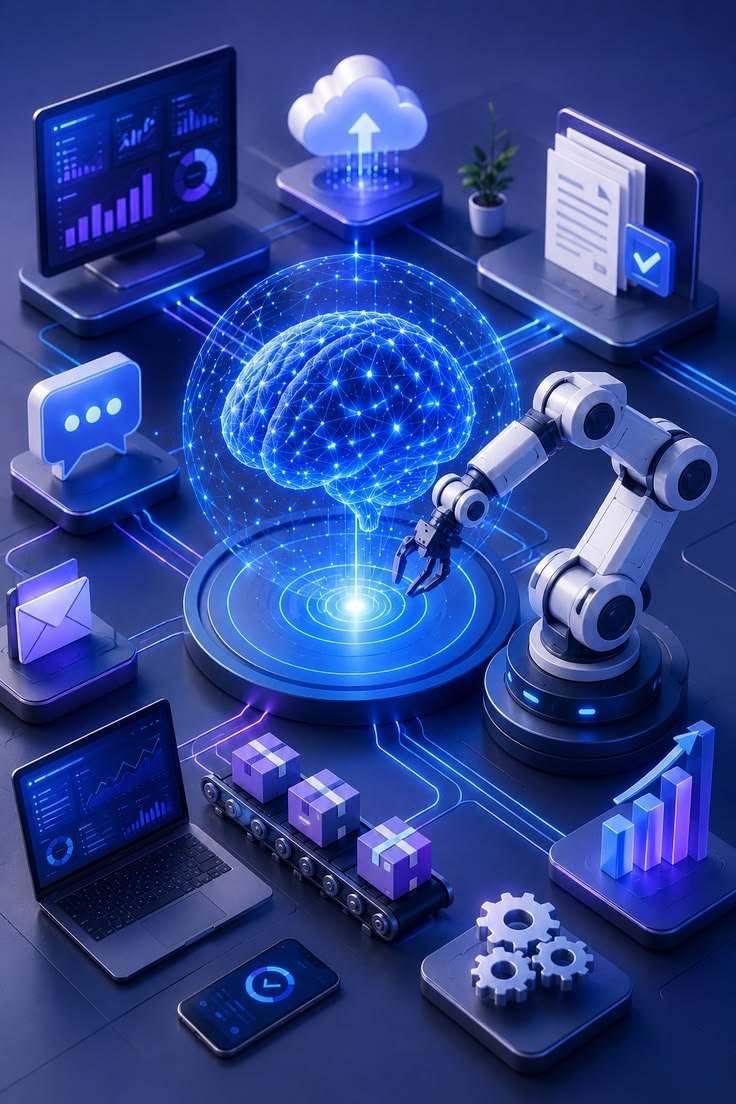
AI Software Development Company Texas: Building Smarter Business Software
Artificial intelligence is changing how businesses build and use software.
Companies are no longer limited to traditional applications that simply store information or follow predefined rules. Modern software can use AI to understand customer requests, analyze data, retrieve information, automate workflows, generate content, and assist employees.
For businesses looking to incorporate these capabilities into their technology infrastructure, choosing the right AI Software Development Company Texas can be an important step.
Custom AI software development can help businesses build applications around their specific processes instead of relying entirely on generic tools.
Businesses interested in AI development, custom software, and automation can explore HiveRift for more information.
What Does an AI Software Development Company Do?
An AI software development company combines artificial intelligence with software engineering.
Depending on the project, development services may include:
- Custom AI applications
- Generative AI
- AI chatbots
- AI agents
- Machine learning
- RAG applications
- Predictive analytics
- Intelligent automation
- API integrations
- Web applications
- Mobile applications
The purpose is to create software that solves a specific business problem.
Why Businesses Are Investing in AI Software
Traditional business software is useful for structured workflows.
AI can add another layer of intelligence.
For example, a traditional application may allow an employee to search a database.
An AI-powered application could allow the employee to ask:
“Which customers have not purchased from us in the last six months?”
The application could interpret the request, retrieve the relevant data, and present the result.
This changes software from simply storing information to helping users interact with and understand it.
Custom AI Software Texas
Businesses often have unique workflows and technology environments.
Custom AI software can be designed around:
- Business processes
- Customer requirements
- Existing applications
- Internal databases
- Industry requirements
- Security policies
- Specific automation needs
For example, a company may need an AI assistant connected to its CRM, internal documents, and customer database.
A generic chatbot may not provide that functionality.
A custom application can be built around the company’s actual requirements.
AI Chatbot Development
AI chatbots are one of the most common applications of AI software development.
Businesses can use chatbots for:
- Customer support
- Lead generation
- Product information
- Appointment assistance
- Internal employee support
- Frequently asked questions
A basic workflow is:
User → AI Understanding → Knowledge Retrieval → Response
More advanced systems can connect to business applications.
For example:
Customer → AI Chatbot → CRM/API → Approved Information → Response
AI Agent Development
AI agents can help software perform multiple tasks.
For example:
New Lead → AI Research → Qualification → CRM Update → Sales Notification
An AI agent may interact with approved tools and systems to complete different workflow steps.
Custom software development makes it possible to define:
- Available tools
- Permissions
- Business rules
- Escalation points
- Human approval requirements
This helps keep AI agents within controlled boundaries.
Generative AI Applications
Generative AI can be incorporated into custom business software for many purposes.
Potential applications include:
- Document summarization
- Content assistance
- Customer support
- Research
- Internal knowledge
- Product information
- Report generation
Instead of employees using a separate AI tool, generative AI can be integrated directly into the applications they already use.
RAG-Powered Applications
Businesses often want AI applications to work with their own information.
Retrieval-Augmented Generation can help achieve this.
A typical workflow is:
User Question → Knowledge Search → Relevant Information → AI Model → Response
RAG can connect AI applications with:
- Company documents
- Product catalogs
- FAQs
- Technical documentation
- Internal policies
- Training materials
This can make AI applications more useful for business-specific questions.
AI Automation Within Software
AI software can also automate repetitive processes.
For example:
Email → AI Classification → CRM → Task → Notification
Another workflow could be:
Document → AI Extraction → Validation → Database
Combining AI with traditional automation can create flexible business workflows.
AI Software for Customer Experience
AI can improve the way customers interact with a business.
Potential applications include:
- AI support assistants
- Product recommendation systems
- Personalized experiences
- Automated customer communication
- Lead qualification
For example:
Website Visitor → AI Assistant → Questions → Recommendation → Lead Capture
This can help businesses engage with customers more efficiently.
AI Software for Sales Teams
Sales teams can benefit from AI-powered software that reduces administrative work.
Potential features include:
- Lead scoring
- Customer research
- Sales summaries
- CRM automation
- Follow-up recommendations
- Customer segmentation
A customized sales application could bring several of these functions together.
AI Software for Business Analytics
AI can help businesses make better use of their data.
Potential applications include:
- Sales forecasting
- Customer segmentation
- Churn prediction
- Demand forecasting
- Operational analytics
- Performance monitoring
The value comes from connecting analysis to actual business decisions.
For example, identifying customers likely to leave is useful when sales teams can use that information to create targeted retention strategies.
AI Document Intelligence
AI software can process large volumes of documents.
Potential documents include:
- Invoices
- Contracts
- Applications
- Forms
- Reports
- Purchase orders
A customized system can extract information and connect it with other business applications.
Document → AI Processing → Data Extraction → Validation → Business System
This can reduce manual data entry.
AI Software Development Across Texas Industries
eCommerce
Businesses can use AI software for:
- Product recommendations
- Shopping assistants
- Customer support
- Personalization
- Demand forecasting
Real Estate
Potential applications include:
- AI property assistants
- Lead qualification
- Property recommendations
- Customer communication
- Document processing
Manufacturing
AI software can support:
- Predictive maintenance
- Quality analysis
- Production optimization
- Demand forecasting
- Operational automation
Healthcare
Healthcare organizations can explore appropriate AI applications for administrative and operational activities.
Examples include:
- Information retrieval
- Scheduling assistance
- Document processing
- Operational analytics
Sensitive healthcare applications require strong privacy, security, validation, and human oversight.
Financial Services
AI software can support suitable applications such as:
- Document analysis
- Fraud detection
- Customer support
- Risk analysis
- Internal knowledge systems
Sensitive financial workflows require appropriate controls.
Hospitality
Hotels and hospitality businesses can explore:
- Guest assistants
- Booking support
- Service request automation
- Customer communication
- Internal workflows
How AI Software Development Works
1. Define the Business Objective
Start by identifying the problem the software needs to solve.
2. Gather Requirements
Understand users, workflows, data, systems, and expected outcomes.
3. Select the AI Approach
Determine whether the project requires:
- Generative AI
- Machine learning
- RAG
- AI agents
- Automation
- Traditional software
4. Design the Architecture
Plan the AI models, application, databases, APIs, cloud infrastructure, security, and user interface.
5. Build a Prototype
A proof of concept can validate the core idea before full development.
6. Develop the Application
Integrate AI with the broader software system.
7. Test
Test functionality, AI responses, integrations, security, performance, and edge cases.
8. Deploy
Release the application to its intended users.
9. Monitor
Track usage, performance, errors, and user feedback.
10. Improve
AI applications should evolve as business requirements and technology change.
How to Choose an AI Software Company Texas
When evaluating an AI Software Company Texas, consider whether the company has experience with both AI and software engineering.
Important capabilities include:
- AI development
- Custom software development
- Generative AI
- Machine learning
- RAG
- AI agents
- API integration
- Cloud development
- Database architecture
- Automation
- Security
The development partner should also understand the business objective behind the project.
Security for AI Software
AI applications can process valuable information, so security should be built into the architecture.
Important areas include:
- Authentication
- Authorization
- Data protection
- Encryption
- Access controls
- API security
- Monitoring
- Audit logs
AI agents should only receive access to the tools and information necessary for their tasks.
Common AI Software Development Mistakes
Building AI Without a Clear Business Goal
AI should solve a real problem.
Choosing Technology Too Early
The business use case should determine the technology.
Ignoring Data Quality
AI applications depend on reliable information.
Overbuilding the First Version
A focused MVP can help validate the concept before expanding.
Giving AI Excessive Permissions
AI systems should operate within defined boundaries.
Ignoring Human Oversight
Human review may be important for sensitive or high-impact decisions.
Forgetting Long-Term Maintenance
AI models, APIs, data, and software requirements can change.
Why HiveRift for AI Software Development?
Building AI-powered software requires multiple technical capabilities.
A project may involve:
AI + Software Engineering + Automation + APIs + Data + Cloud Infrastructure
HiveRift works across AI development, machine learning, custom software development, automation, web applications, mobile applications, and other digital technology solutions.
This broader approach can help businesses build AI applications that fit into their existing technology environment.
Businesses looking for custom AI software development can explore HiveRift to learn more about its technology services.
Responsible AI Software Development
AI software should be developed with appropriate safeguards.
Businesses should consider:
- Data privacy
- Security
- Accuracy
- Human oversight
- Access control
- Monitoring
- Transparency
- Risk management
The NIST AI Risk Management Framework provides useful guidance for organizations working with AI systems.
The Future of AI Software
The next generation of business software is likely to combine several technologies.
For example:
Generative AI + RAG + AI Agents + Automation + APIs + Business Data
This can allow applications to understand natural-language requests, retrieve information, make recommendations, and complete approved actions.
AI will increasingly become a component of everyday business software rather than a separate tool.
Final Thoughts
Choosing the right AI Software Development Company Texas can help businesses move from AI experimentation toward practical software solutions.
Custom AI applications can support customer service, sales, automation, analytics, document processing, internal knowledge, and many other business functions.
However, successful AI software development begins with a clear business problem.
Businesses should identify the objective, understand their data, choose the appropriate AI approach, plan integrations, build a focused solution, test it carefully, and measure the results.
The best AI software is not necessarily the most complex.
It is the software that fits the business, solves a meaningful problem, and creates measurable value.
FAQs
What does an AI software development company do?
An AI software development company designs and builds applications that use artificial intelligence alongside traditional software technologies.
What types of AI software can businesses build?
Businesses can develop AI chatbots, AI agents, RAG applications, predictive analytics systems, recommendation engines, document-processing applications, and intelligent automation platforms.
Can AI software integrate with existing business systems?
Yes. AI applications can integrate with CRMs, databases, ERPs, websites, mobile apps, and other business systems through APIs and appropriate integration methods.
Is custom AI software better than ready-made AI tools?
It depends on the business requirements. Custom software can provide greater flexibility when a company’s workflows, integrations, or data requirements are not supported by standard tools.
Can small businesses build AI software?
Yes. Small businesses can start with focused applications such as customer-support chatbots, lead qualification, document processing, or workflow automation.
How much does AI software development cost?
Costs depend on application complexity, AI requirements, integrations, data, security, infrastructure, development time, and ongoing maintenance.


